Showing posts with label yield. Show all posts

Wednesday, February 20, 2019

Top 10 Highest Yield Dividend Champions

Top 10 Highest Yielding Dividend Champions
Highest Yielding Dividend Champions

A key objective in Dividend Farming is the development of a cash flow stream through dividend payments.  Strategically speaking, it’s important that dividend growth is compounded at a rate greater than inflation e.g., Consumer Price Index (CPI).  If not, the purchasing power of your cash flow erodes over time. 

Inflation beating compound growth may be achieved in several ways.  Investing in firms growing dividend payments quickly, acquiring companies with stable dividend yields greater than the CPI, or a combination of the two are all possible.

The table below highlights Dividend Champions with the 10 highest dividend yields among those raising their dividends for 25 or more years as of 1.31.19.  These data points are drawn from the DRIP Investing site which is a great place to begin looking for solid dividend paying firms that can help build an inflation besting dividend stream.

10 Highest Yielding Dividend Champions
Company
Yield
Dividend Payment
AT&T Inc.
6.79
$0.5100
Altria Group Inc.
6.48
$0.8000
Tanger Factory Outlet Centers
6.15
$0.3500
Universal Corp.
5.20
$0.7500
Urstadt Biddle Properties
5.14
$0.2750
Helmerich & Payne Inc.
5.07
$0.7100
Mercury General Corp.
4.85
$0.6275
ExxonMobil Corp.
4.48
$0.8200
People's United Financial
4.27
$0.1750
Chevron Corp.
4.15
$1.1900

Full disclosure note:  AT&T and Altria are both in my portfolio and have been for years. 

With that said, firms in this list deliver dividend yields above the 2018 Consumer Price Index (CPI) as reported by the U.S. Bureau of Labor Statistics.  The All Items Index for the 2018 12-month period was 1.6%.  This means the companies shown provided a range of dividend payments more than twice the inflation rate to nearly 6 times as great!  These companies have been growing their payments for more than a quarter century and it stands to reason based on the previous Top 10 post regarding Dividend Champions that the growth will continue.

As an investor you have many choices.  Among those are growth company investments in which investors hope the companies grow as forecast.  Alternatively, you can dive into large, solid firms that aren’t Wall Street darlings but reliably put cash in your pocket every quarter.  Those cash payments compound until you’re ready to use them producing an amazing crop for your future self and family.  When that happens, you may look back at your past self and say thanks for choosing to become a Dividend Farmer.

The thoughts and opinions expressed here are those of the author, who is not a financial professional.  Opinions provided should not be considered investment advice.  They are presented for discussion and entertainment purposes only.  For specific investment advice or assistance, please contact a registered investment advisor, licensed broker, or other financial professional.

Saturday, January 12, 2019

Yield on Cost Math


It’s a news flash, I know, but I’m a fan of compounding dividend payments.  More so if those payments deliver annual increases, even if small.  In previous posts, Why Yield on Cost Matters and Why Yield on Cost Matters: II, I began the discussion of the concept, then expanded it with examples of why I think it’s important for Dividend Farmers to pay attention.

Below is a table demonstrating the math behind the yield on cost principle of dividend paying stocks.

Year
Buy Price
Initial Div
Initial Yield
Div. Increase
Div
Yield on Cost
1
$40.00
$2.00
5%
      %        
$2.00
5.0%
2


3.0%
$2.06
5.2%
3


3.0%
$2.12
5.3%
4


5.0%
$2.23
5.6%
5


2.0%
$2.27
5.7%
6


3.0%
$2.34
5.9%
7


3.0%
$2.41
6.0%
8


1.7%
$2.45
6.1%
9


2.0%
$2.50
6.3%
10


2.4%
$2.56
6.4%

The data represent a progression from which you might benefit with a solid, dividend paying firm.

In this example, a $40.00 stock is purchased and pays an initial dividend of $2.00 annually resulting in a nice 5% initial yield or yield on cost.  In year two, the firm declares a dividend increase of 3%.  It doesn’t sound like much on a $2 dividend.  In monetary terms it represents $0.12, which may not impress the trading crowd.

Every year you hold the stock, the company rewards you with a small dividend increase that varies from year-to-year.  Sometimes it’s a little larger, others smaller.

At the end of 10 years, assuming the raises shown, the dividend on your original $40 stock will have grown, through compounding, to $2.56 resulting in a 6.4% yield on the original cost.  Again, this won’t make certain investors salivate, but the change in dividend and yield from purchase through the end of year 10 represents a 28.0% increase relative to the initial dividend and yield. 

A similar progression of small dividend increases across a 20 year holding period means your dividend payment and yield could readily increase by 70%.  It’s true you have to be disciplined and patient to hold for this length of time.  And there’s always a chance regular dividend increases may not materialize.  However, companies with lengthy histories of dividend payments and increases tend to have great inertia behind the dividend and work diligently to maintain it, improving your odds of being a successful Dividend Farmer.

The thoughts and opinions expressed here are those of the author, who is not a financial professional.  Opinions expressed here should not be considered investment advice.  They are presented for discussion and entertainment purposes only.  For specific investment advice or assistance, please contact a registered investment advisor, licensed broker, or other financial professional.

Wednesday, November 28, 2018

6 Reasons Dividend Stocks Beat Bonds


U.S. Treasury Bond
U.S. Treasury Bond
Bonds.  Are.  Confusing.  That’s it in a nutshell.  However, it doesn’t provide an explanation nor does it make for a good post so I’ll continue.

Whether you’re discussing Yield to Maturity, Pricing, Tax Equivalent Yield, Coupons, Duration, Callability, Convertibility, or any number of other characteristics of the bond world, it’s wise to be conversant in bond effluvia to avoid the classic “circle the drain” move with your investment funds.

Below are 6 reasons dividend stocks beat bonds.

  1. Bond yields move opposite to bond prices.  When one goes up, the other goes down.  It doesn’t matter which one moves, the other generally moves in opposition.  This is a function of the math involved in pricing the bonds as well as the laws of supply and demand in relation to the going rate of interest or yield on similar bonds.  Dividend paying stocks may see yields and price moving in opposite directions, but when they do it’s generally because the price of the stock has been bid up while the dividend payment remains unchanged resulting in a smaller yield.  It’s not a function of supply / demand and the involved application of algebra that cause the inverse movement.
  2. Bond valuations are complex.  Establishing the value of such investments requires detailed knowledge or analysis of the variables mentioned earlier that go into the formulation of such securities.  Dividend paying stocks of large, established firms provide ample financial data and profile information about the company allowing even DIY investors to determine a certain level of value.  An investor can decipher the income statement and balance sheet of Parker Hannifin to determine whether the stock price accurately reflects the operations of the company.  Conversely, the same investor may undergo a non-trivial level of angst in attempting to understand the true value of a corporate bond with a yield to maturity of X, a duration of 12 years (9 years remaining), sold into a rising interest rate environment, with or without attendant tax consequences.
  3. Complexity leads to excess fees.  Because bonds are complex few laymen understand them.  Consequently, investing in bonds requires the assistance of a professional who charges fees for the assistance.  Alternatively, substantial losses may be incurred as an investor learns “on the job”, dropping money along the way, because he wanted to avoid the costly professional.  When it comes to dividend stock investing, there are plenty of tools readily available to help investors along the path.  From DRIPInvesting.org to Yahoo.Finance to Investopedia, the number of low or no-cost resources are too numerous to mention.  In addition, it’s easier for an investor to understand what Home Depot does than what’s involved with a municipal general obligation bond, due in 2035, floated 6 years ago by Whatchamacallit County.
  4. Bond yields are fixed.  From the time a bond is floated to the time it reaches maturity or is called, the payment or coupon is rarely if ever increased.  Divided paying stocks can and do increase their dividend payments over time.  In fact, many companies will raise their dividend payments annually with some having done so many years in a row.  As a result, a dividend stock can provide small, regular increases in cash flow while a bond cannot.  Case in point, part of my dividend portfolio has seen an average increase in the dividend payment of more than 4% across the investments in that basket during the past year.
  5. Lender vs owner.  They say owning has its privileges.  If true, bond purchases make you a lender while dividend stock purchases make you a part owner in the firm.  As a part owner, you have voting rights.  You get a say in what the company does and how it does it.  As a bond holder, you don’t.  Granted, as a part owner, you’ll be in line behind the lenders (bond holders) if the firm goes belly up.  However, if your decision to invest is based on where you stand in line when the corporate carcass is divided, then maybe you shouldn’t be investing in that firm in the first place.
  6. Convertability.  Some bonds are convertible to stock after a certain period of time.  In other words, the lender (see #5) is granted the opportunity to become part owner of the enterprise.  Stock holders are not offered the chance to convert their stock to bonds moving from owner to lender.  That one-way street should offer pause when considering which is better.  Why would I be offered the possibility of converting from a bond to a stock, but not the other way?  Maybe because one is better than the other?

James Bond 007
James Bond 007
In fairness to bonds, my favorite spy was named Bond.  James Bond.  He liked his martinis shaken, not stirred.  I like my investments neither shaken nor stirred (converted?) as a general rule of thumb.  So while I enjoy Bond on the big screen, I’m not sure about Bonds in my portfolio.  Are you?


The thoughts and opinions expressed here are those of the author, who is not a financial professional.  Opinions expressed here should not be considered investment advice.  They are presented for discussion and entertainment purposes only.  For specific investment advice or assistance, please contact a registered investment advisor, licensed broker, or other financial professional.
    

Tuesday, November 20, 2018

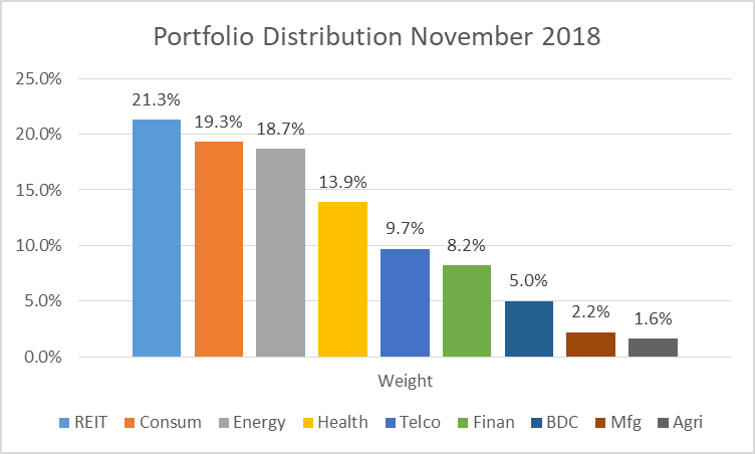
Portfolio: November 2018


The November Dividend Farmer update saw a shift in portfolio weight relative to October.  Changes to weights at the bottom end of the basket were attributable to the addition of 100 shares of a telco.  Conversely, changes to weighted position at the top end were due mostly to REIT holdings all paying dividends, automatically reinvested, during the month.

November dividend income streamIn monitoring news articles and blogs no issues were found to be overly concerning regarding my holdings.  Once again, I’m not checking ticker symbols on a regular basis since my focus is on building the dividend income stream rather than market value.  Consequently, I try to focus on substantive issues adversely affecting the abilities of the investments to generate cash and didn’t find any in headline.  

The yield relative to current price bumped up from 3.82% in October to 3.84% in November due to the addition of the telco stock with an individual yield sufficiently high that it moved the portfolio yield ever so slightly.  All dividends are automatically reinvested with no transactions fees.  Unweighted average yield on cost is about 4.6%; nearly 1% higher than the current yield on price of 3.84%.

The average monthly dividend from this basket has now surpassed $1,100 – by a few bucks.  That doesn’t pay all the bills, but it is nice supplemental income if needed.  The trailing 1-year CAGR ballooned from 10.6% to 12.6%.  In looking at past history, jumps like these appear to coincide with dividend increases announced by multiple holdings in a single month.  Each month accelerates the income stream growth through the power of compounding.  The Compound Growth post offers more detail about the power of compounding your dividends through automatic reinvestment.

The thoughts and opinions expressed here are those of the author, who is not a financial professional.  Opinions expressed here should not be considered investment advice.  They are presented for discussion and entertainment purposes only.  For specific investment advice or assistance, please contact a registered investment advisor, licensed broker, or other financial professional.


Monday, October 29, 2018

Portfolio: October 2018


It’s time for the monthly update on my crop’s progress which is important as a Dividend Farmer.  Since the September update, there have been no major events adversely affecting my current holdings.

Although I monitor news articles and blogs for activity that might be unfavorable to my basket of stock, I’m not checking ticker prices on a daily basis.  Doing so invites a level of consternation I don’t need.  Instead, each investment is reviewed monthly to update dividend increases, price changes, and increases in stock quantities due to reinvested dividends paid during the month.

Not many changes relative to last month and no additions to principle.  However, due to dividend reinvestments in some segments, but not others, the percentages across segments have shifted slightly.  For instance, REITs were my top holding last month, but slid into second position in October.  Telco and Finance swapped rank order this month as well.  

Dividend Portfolio - October

The yield relative to current price dipped from 3.86% in September to 3.82% in October due to stock price increases across various holdings.  All dividends are automatically reinvested with no transactions fees.  Unweighted average yield on cost is approaching 4.6%; nearly 1% higher than yield on price.

The average monthly dividend from this basket is approaching $1,100.  That won’t pay all the bills, but it’ll put a nice dent in them if needed.  With a trailing 1-year CAGR of 10.6%, the long-term dividend farming strategy embarked upon 8 years ago is approaching the point of critical mass.  If you check out the Compound Growth post you’ll gain a sense of what I mean.


The thoughts and opinions expressed here are those of the author, who is not a financial professional.  Opinions expressed here should not be considered investment advice.  They are presented for discussion and entertainment purposes only.  For specific investment advice or assistance, please contact a registered investment advisor, licensed broker, or other financial professional.